

242: The Year of Two Pharaohs (Sety II vs Amenmesse)
Between 1215 and 1211 BCE, Egypt was divided. A rebellion in the south, launched by Amen-messe "Born of Amun" disrupted the succession of Sety II, son of Merneptah. Records from this shadowy period hint at violence and corruption in Waset/Luxor, as the usurper took control and established a new regime. The impact of this conflict would have long-lasting ramifications for the 19th Dynasty...
Music: Luke Chaos.
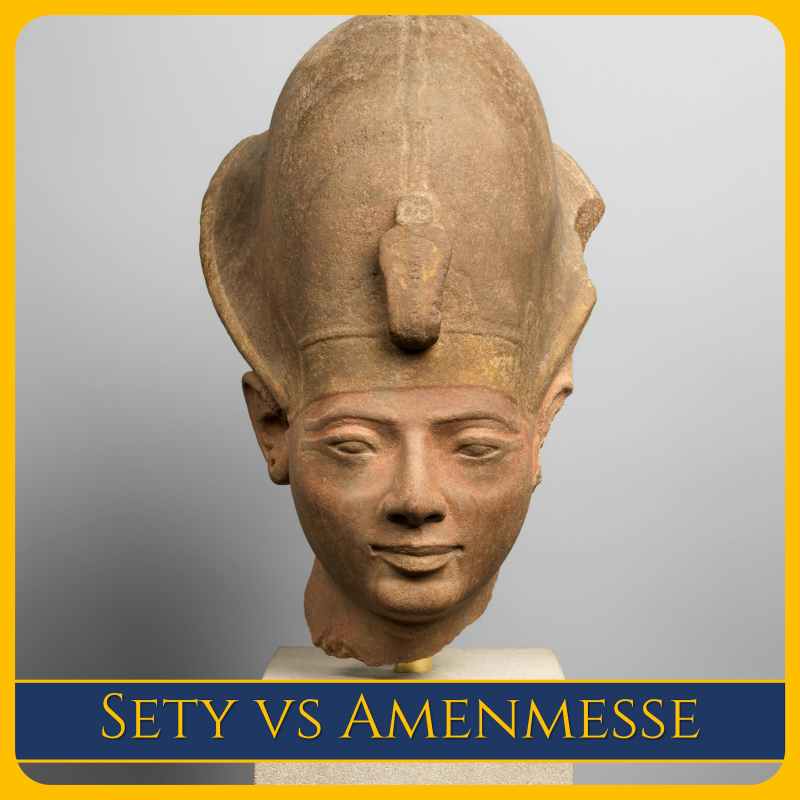
Logo: An unnamed statue head from Karnak, probably depicting Sety II or Amenmesse (Metropolitan Museum of Art, public domain).
Was Amenmesse the Viceroy Messuy?
Below are scenes from Amada in Nubia, where Messuy carved scenes of himself before royal cartouches. Prof. Aidan Dodson suggests that the Viceroy has cobra/uraei on his forehead, though other scholars suggest this is mere weathering. What do you think?
Photos (high-res) https://www.flickr.com/photos/184518985@N04/
Bibliography
Brand, P. J. (2009). Usurped Cartouches of Merenptah at Karnak and Luxor. In P. J. Brand & L. Cooper (Eds.), Causing His Name to Live: Studies in Egyptian Epigraphy and History in Memory of William J. Murnane (pp. 29–48). Brill. http://history.memphis.edu/murnane/Brand.pdf
Caminos, R. A. (1974). The new-kingdom temples of Buhen. Egypt Exploration Society.
Černý, J. (1929). Papyrus Salt 124 (Brit. Mus. 10055). The Journal of Egyptian Archaeology, 15(3/4), 243–258. https://doi.org/10.2307/3854120
Cooney, K. M. (2022). The New Kingdom of Egypt Under the Ramesside Dynasty. In D. T. Potts, N. Moeller, & K. Radner (Eds.), The Oxford History of the Ancient Near East, Volume III: From the Hyksos to the Late Second Millennium BC (pp. 251--366). Oxford University Press. https://doi.org/10.1093/oso/9780190687601.003.0027
Dodson, A. (2016). Poisoned Legacy: The Decline and Fall of the Nineteenth Egyptian Dynasty (Revised edn). American University in Cairo Press.
Hopper, R. W. (2010). The Monuments of Amenmesse and Seti II: A Historical Inquiry [Unpublished PhD. Thesis]. The University of Memphis.
Iskander, S. (2002). The Reign of Merneptah [Unpublished PhD. Thesis]. New York University.
Kitchen, K. A. (1987). The Titularies of the Ramesside Kings as Expression of their Ideal Kingship. Annales Du Service Des Antiquités de l’Égypte, 71, 131--141. https://archive.org/details/ASAE-71-1987
Krauss, R. (1976). Untersuchungen zu König Amenmesse (1. Teil). Studien Zur Altägyptischen Kultur, 4, 161--199. https://www.jstor.org/stable/25150008
Krauss, R. (1977). Untersuchungen zu König Amenmesse (2. Teil). Studien Zur Altägyptischen Kultur, 5, 131--174. https://www.jstor.org/stable/44324535
Krauss, R. (1997). Untersuchungen zu König Amenmesse: Nachträge. Studien Zur Altägyptischen Kultur, 24, 161--184. https://www.jstor.org/stable/25152736
Krauss, R. (2000). Moïse le pharaon (N. Baum, Trans.). Editions du Rocher.
Lefébure, E. (1886). Les hypogées royaux de Thèbes (Band 1): Le tombeau de Séti Ier. Libraire de la Societe Asiatique. http://digi.ub.uni-heidelberg.de/diglit/lefebure1886bd1
Leprohon, R. J. (2013). The Great Name: Ancient Egyptian Royal Titulary. Society of Biblical Literature.
Schneider, T. (2011). Conjectures About Amenmesse: Historical, Biographical, Chronological. In M. Collier & S. Snape (Eds.), Ramesside Studies in Honour of K. A. Kitchen (pp. 445--451). Rutherford. https://www.academia.edu/6374977/Conjectures_about_Amenmesse_Historical_Biographical_Chronological_in_Ramesside_Studies_Festschrift_Kenneth_A_Kitchen_Bolton_Rutherford_Press_2011_445_451
Servajean, F. (2014). Mérenptah et la fin de la XIXe dynastie. Pygmalion.
Sourouzian, H. (2019). Catalogue de la statuaire royale de la XIXe dynastie. Institut français d’archéologie orientale. https://www.ifao.egnet.net/publications/catalogue/9782724707571/
Yurco, F. J. (1979). Amenmesse: Six statues at Karnak. Metropolitan Museum Journal, 14, 15--31. http://www.jstor.org/stable/pdfplus/1512735.pdf
Learn more about your ad choices. Visit megaphone.fm/adchoices
Popis podcastu
Ancient Egypt, from Creation to Cleopatra. This podcast tells the story of pharaonic Egypt "in their own words." Using archaeology, ancient texts, and up-to-date scholarship, we uncover the world of the Nile Valley and its people. Hosted on the Airwave Media Network.